For years, the commercial real estate (CRE) industry has operated in a season of “pledges.” But as we enter 2026, the calendar has become the industry’s most demanding regulator. With 2030 climate targets only four years away, the “wait and see” approach has been replaced by a mandate for physical execution.
In 2026, ESG is no longer a marketing line—it is a capital requirement. Assets that fail to show real-world decarbonization progress are facing “brown discounts” and tightening credit. Here is how leading owners are moving from high-level net-zero goals to concrete, ROI-positive projects.
The Regulatory Hammer: Building Performance Standards (BPS)
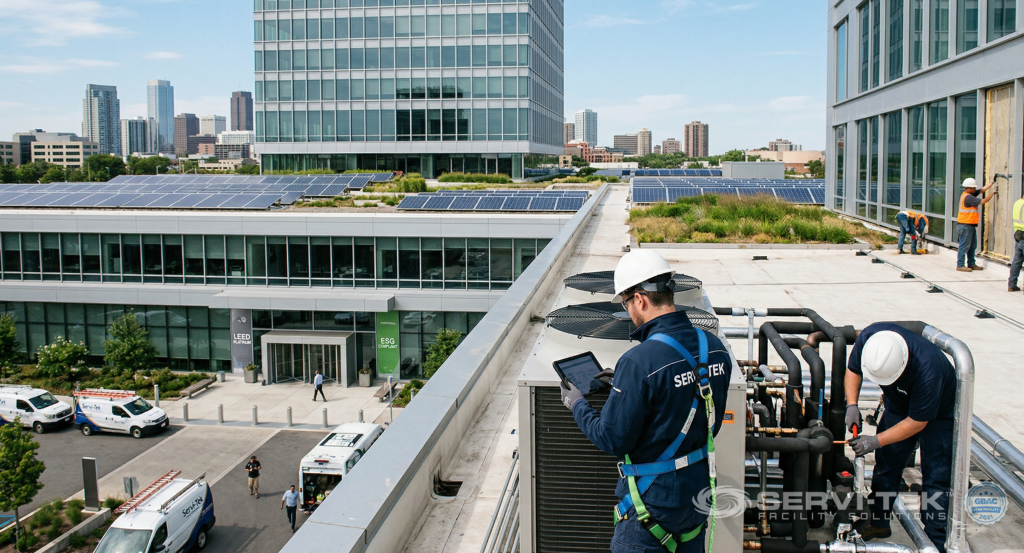
The most significant shift in 2026 is the transition from voluntary benchmarking to mandatory performance. Cities like New York, Boston, Seattle, and Washington D.C. have officially moved into enforcement phases for Building Performance Standards.
Penalties as a Math Problem
Owners are no longer looking at fines as a distant possibility. In 2026, many face recurring monthly penalties—some reaching $5,000 per month—for exceeding emissions caps.
The Compliance Audit
Leading owners are using Q1 to run “BPS impact analyses.” They aren’t just asking if they are compliant today, but where they will be in 2030 based on current energy trajectories.
The Project Pipeline: Prioritizing the “Fabric First”
Execution in 2026 starts with the building envelope. Before spending millions on high-tech mechanicals, smart owners are fixing the “leaky bucket.”
High-Performance Retrofits
Upgrading glazing, improving insulation, and sealing building envelopes are the priority projects for 2026. These “passive” upgrades reduce the total load, allowing for smaller, cheaper mechanical systems later.
The Heat Pump Pivot
Industrial-grade heat pumps have become the standard for 2026 boiler replacements. Driven by the Section 179D tax deduction (now up to $5.81/sq ft), owners are aggressively electrifying heating and cooling to decouple from fossil fuels.
Financial Engineering: Funding the Transition
The “how do we pay for it” question has new answers in 2026. Traditional equity is being supplemented by innovative green financing.

C-PACE Financing
Commercial Property Assessed Clean Energy (C-PACE) is being used to fund 100% of energy-efficiency project costs with long-term, non-recourse capital.
Sustainability-Linked Loans (SLLs)
We are seeing a surge in debt where the interest rate is “stepped down” as the building hits specific EUI (Energy Use Intensity) reduction targets. In 2026, your building’s carbon footprint directly dictates your cost of capital.
The “S” in ESG: Health as an Asset Value
While environmental goals dominate the headlines, the “Social” aspect of ESG is proving to be a major rent driver in 2026.
Indoor Environmental Quality (IEQ)
Owners are investing in advanced HEPA filtration and circadian lighting. In a bifurcated office market, buildings with WELL or Fitwel certifications are seeing significantly higher retention rates and lower vacancy.
Tenant Collaboration
Since tenant energy use accounts for up to 80% of a building’s footprint, 2026 projects include “Green Leases” that incentivize both parties to save energy, sharing the financial rewards of efficiency.
The Bottom Line
In 2026, the market has no more patience for “aspirational” net-zero goals. The value of a property is now intrinsically linked to its decarbonization velocity. Those who execute real projects today are securing lower capital costs, better tenants, and a resilient future.